
12 Games Like Heads Up (When You Have Played Every Deck)
Apps and party games for when the decks run out — including the ones that fix waiting your turn and sharing a single phone.
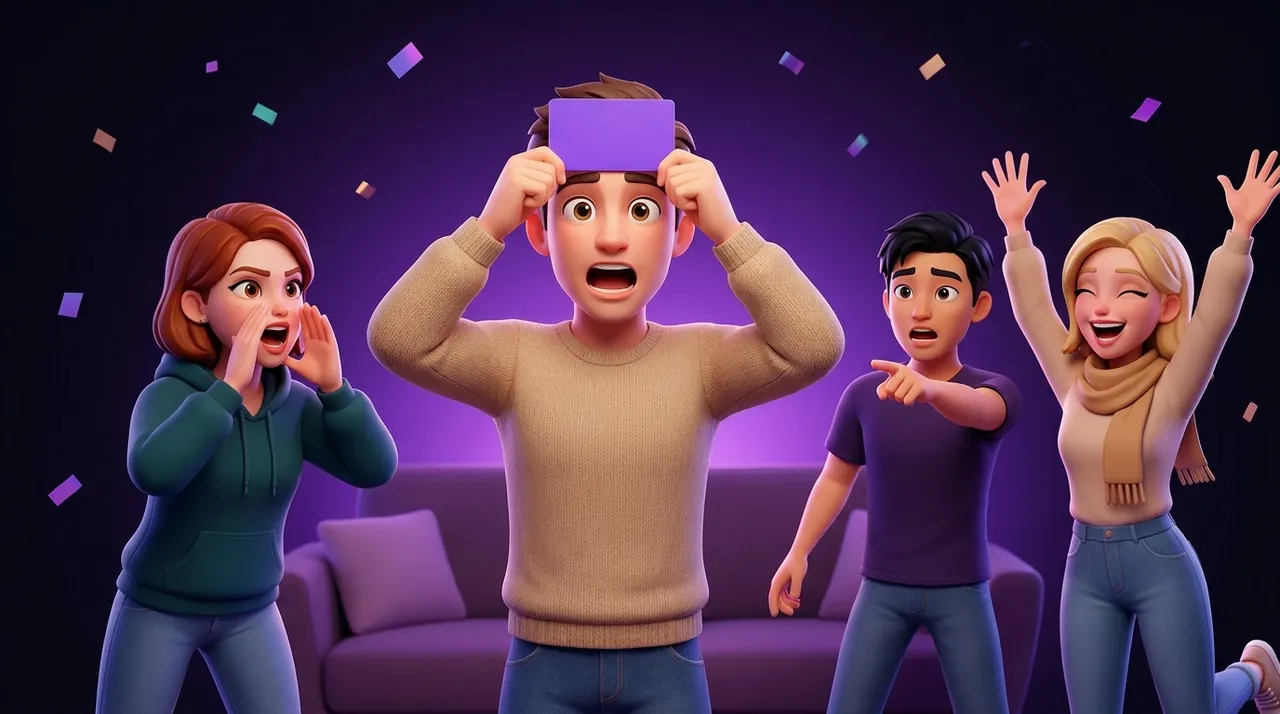
Heads Up is close to a perfect party game for the first hour. You hold the phone to your forehead, your friends shout clues, and the timer does the rest. Then you finish the decks.
Buying more packs helps for a while, but it does not fix what actually wears out. Only one person plays at a time — everyone else is an audience. And the whole group shares one phone, which means the game happens in a queue. This list is sorted by which of those two things you want to solve.
What people are actually looking for
| Game | Players | Everyone plays at once? | Needs |
|---|---|---|---|
| Monikers | 4–20 | No (teams) | The box |
| Time’s Up! | 4–12 | No (teams) | The box |
| Charades apps | 4–20 | No | One phone |
| Fishbowl | 6–16 | No (teams) | Paper and pens |
| Psych! | 3–6 | Yes | A phone each |
| Jackbox Party Pack | 3–8 | Yes | A screen + a phone each |
| Wavelength | 2–12 | Yes | The box |
| Just One | 3–7 | Yes | The box |
| Codenames | 4–8 | Yes (teams) | The box |
| Spyfall | 3–8 | Yes | The box or an app |
| Cards Against Humanity | 4–20 | Partly | The box |
| Hidden Agenda | 2–25 | Yes | A phone each |
If you want more of the same
1. Monikers
The physical game that Heads Up players tend to love most. You get a deck of names — historical figures, fictional characters, absurd concepts — and play three rounds with the same cards. Round one, describe freely. Round two, one word only. Round three, mime.
The reason it works is the escalation: by round three, “the guy from the thing” is enough, because the group has built a shared shorthand. Same core skill as Heads Up, structured so it gets better as it goes rather than running out.
Best for: groups who genuinely like the charades format and want the good version.
2. Time’s Up!
The same three-round idea, usually with a deck of famous names. Slightly more classic, slightly less irreverent than Monikers. If you liked the celebrity decks in Heads Up specifically, this is the closer match.
Best for: mixed ages, family gatherings.
3. Charades apps
There are dozens of free apps using the forehead-and-tilt format with their own categories. They are the most direct swap and they cost nothing — but be clear-eyed that they solve the content problem, not the structural one. You will finish these decks too.
Best for: tonight, when you need something in thirty seconds.
4. Fishbowl
The free version of Monikers. Everyone writes names or phrases on scraps of paper into a bowl, and you play the same three rounds. Because the group writes the clues, the deck is perfectly tuned to the people in the room — inside jokes included.
Needs nothing but paper, pens and a bowl.
Best for: zero budget, sixteen people, no planning.
If you are tired of waiting your turn
5. Psych! Outwit Your Friends
Everyone invents fake answers to a real trivia question, then the group votes. You score both for guessing right and for fooling other people, and everyone plays every round on their own phone.
Best for: the smallest possible jump away from Heads Up.
6. The Jackbox Party Packs
The standard answer for a group with a TV. One shared screen runs the game; everyone else uses their phone as a private controller. Quiplash and Fibbage in particular are all-play, all-round, and the phones mean quiet players contribute as much as loud ones.
The catch is setup: a screen, a console or laptop, and everyone on the same wifi.
Best for: living rooms with a TV and eight people.
7. Wavelength
One player sees a spectrum — overrated to underrated, safe to dangerous — with a hidden target, and gives a single clue. Everyone else argues about where on the dial it belongs.
Nobody performs. The whole game is the argument, which is why it lands with groups who quietly hated being made to mime.
Best for: people who like talking more than acting.
8. Just One
Cooperative word guessing where everyone writes a clue simultaneously — and identical clues cancel out before the guesser sees them. Fast, gentle, and it plays with people who claim not to like games.
Best for: mixed groups, older relatives, low-energy evenings.
9. Codenames
Two teams, a grid of words, and one clue-giver per team trying to link several words with a single clue. Everyone on the team is thinking every round, even when it is not their turn to speak.
Best for: groups who want something genuinely clever.
10. Spyfall
Everyone shares a secret location except one player. Questions go round; answer too vaguely and you look like the spy, too precisely and you hand the location to them. Eight-minute rounds, and everybody is playing the whole time. It belongs to a whole genre worth exploring — see our guide to social deduction games.
Best for: small groups, quick rounds.
11. Cards Against Humanity
Worth naming because it is what many groups reach for next, though it only partly solves the turn problem — one judge per round, everyone else plays. Content-dependent, and it ages faster than the others here.
Best for: groups who know exactly what they are getting.
12. Hidden Agenda
Being upfront: this one is ours, and it exists specifically because of the two problems at the top of this page.
Nobody waits their turn, because everyone plays at the same time. Nobody passes a phone, because each player has their own. Each person draws three secret missions to pull off during the conversation — steer the topic somewhere specific, get someone to repeat a phrase back to you, win an argument you deliberately started — and scores the ones nobody notices. In Catch mode you can call out a player you think just ran one, and the host settles it out loud.
The real difference from Heads Up is that there is nothing to start. No timer, no phone in the middle of the table, no turning to face the group. The party carries on and the game runs underneath it, which is why it does not empty out after two hours the way a deck does.
Best for: parties and pre-drinks where you would rather not interrupt anything. Two players is enough, and it works with twenty. Free on the App Store.
Picking one tonight
Keep the charades energy: Monikers if you can buy something, Fishbowl if you cannot.
Stop waiting your turn: Jackbox if there is a TV, Psych! if there is not.
Never perform again: Wavelength or Just One — or go further into games that are purely conversation.
Do not stop the party at all: Hidden Agenda.
Frequently asked
What game is most similar to Heads Up?
Monikers, if you want the physical version — the same guess-the-name idea, but played in three rounds with the same cards, so the third round is one-word clues and mime. For an app that plays almost identically, most free charades apps use the same forehead-and-tilt format with their own word packs.
Why does Heads Up get boring?
Two reasons, and both are structural rather than a content problem. Only one person plays at a time while everyone else watches, and the whole group shares a single phone. Buying more decks fixes neither. Games where everyone plays simultaneously — Jackbox, Hidden Agenda, Spyfall — do not run out in the same way.
What can we play if everyone has their own phone?
The Jackbox Party Packs are the best known: one screen shows the game and everyone answers privately on their own phone. Hidden Agenda takes it further — there is no shared screen at all, and each player gets secret missions to pull off during the conversation.
Is there a free alternative to Heads Up?
Several. Charades-style apps are largely free with optional packs, Fishbowl needs nothing but paper and pens, and Hidden Agenda is free to download with a full pack of missions included.
What is a good Heads Up alternative for adults at a party?
Monikers for a group that wants to keep the charades energy, Wavelength for a group that would rather argue than perform, and Hidden Agenda if the party is already going and you do not want to stop it to start a game.